Es mostren els missatges amb l'etiqueta de comentaris English reviews. Mostrar tots els missatges

dilluns, 1 de maig del 2017

The dispatcher - John Scalzi (english review)

Disclaimer: English is my third language,  so I want to apologize in advance for there may be mistakes in the text below. If you find any, please let me know so that I can correct it. I'd really appreciate it. Thanks. You can read this review also in spanish here.

Surely John Scalzi is the author of which I have commented more books on the blog; novel that publishes, novel that I read. Today I present to you a novella, The dispatcher, that doesn't follow his habitual line of work.

The plot is based on a surprising and inexplicable event: when a person is killed, after a few minutes his body disappears from the crime scene and appears naked in his bed alive and kicking. If you die of accident, illness or suicide this does not happen. Logically this causes major changes in society.
This premise allows Scalzi to create the figure of the Dispatcher, a killer who specializes in killing people just before they die from natural death or an accident. Although the figure is legalized and in principle controlled by an agency, it opens a wide range of possibilities of action of this occupation in no regulated and hidden situations. Scalzi squeezes this field of action and presents a great variety of situations, using his great imaginative capacity.
The story begins when a Dispatcher is kidnapped, and the police asks one of their companions for help in conducting the investigation.
I said at the beginning that this novel escapes its usual line, since it is a typical detective story, and Scalzi is specialized in Space-opera. As usual in his work, the story is explained mainly through the dialogue between the characters, Scalzi is a master in this resource. Humor, another specialty of the house, is also present, although less than in other of his books, and is more black humour.
In short, a very entertaining novella with a very original premise to which the author knows how to extract the juice (although it gives for much more, I would like to visit this scenario again). Totally recommended.

dissabte, 15 d’abril del 2017

Avengers of the moon - Allen Steele (english review)

Disclaimer: English is my third language,  so I want to apologize in advance for there may be mistakes in the text below. If you find any, please let me know so that I can correct it. I'd really appreciate it. Thanks. You can read this review also in spanish here.

In the 40s of the last century the writer Edmond Hamilton published a series of science fiction Pulp novels whose protagonist was Captain Future. In the 70s several of these novels were republished, and appeared an anime version of 53 episodes that was very successful in several countries. The series and books have so many followers that an adaptation to the big screen is planned. I was surprised, because I had never heard of this Pulp magazine hero.
The stories of Captain Future are located in the near future (in the first novels in 1990 ...) in which we have colonized and even terraformed some of the bodies of the solar system.

The real name of the Captain Future is Curtis Newman. His parents, two important scientists, were killed when he was a baby, and he was taken care of by three rather singular characters: Grag, a smart robot, Otho, a white-skinned droid, and Professor Wright, a former collaborator of his parents who was about to die of an illness and whose brain is stored in a transparent and mechanized case that allows movement and communication with his peers.
Under the tutelage of these three picturesque characters Curtis grows in a secret moon base, hidden to avoid being found by the murderers of his parents. Curtis ends up being an excellent scientist and a great athlete. His scientific background will allow him to invent various gadgets that will help him in his adventures.
In these adventures he will also be accompanied by Joan Randall, a beautiful agent of the planetary police who provides the inevitable feminine factor to the story and for which Curtis is attracted.

The American writer Allen Steele has paid homage to this saga, and in the novel Avengers of the Moon has rewritten the origin of this character and his first adventure, but with the scientific knowledge and a style of our time. The result is an entertaining, somewhat naive, adventure story of classic science fiction.
Some aspects of the plot and the setting are very interesting, such as the terraforming process of the planets, the genetic modifications necessary to live in the different conditions of the bodies of the solar system, the sociological consequences of these modifications and the presence on the moon of some glyphs written by an extraterrestrial species from Deneb.

The main problem is that the tone of the story in the moments of action and adventure is a little ingenuous, even in some moments childish: the good are very good, the bad are very bad, the protagonists are always smarter than the others, the bad guy explains his plans when what he would have to do is eliminate the protagonist (typical situation of James Bond films) ...
The aspiration of the novel is to entertain, and in that is a success, but I would have liked more that it had deepened in some political and sociological aspects of this universe. Therefore I recommend you if you are looking for an evasion reading exclusively. You will have a good time.
I do not know if Allen Steele intends to continue the stories of Captain Future. If he does, here he will find an interested reader, this universe has aroused my curiosity.

diumenge, 9 d’abril del 2017

The end of the day - Claire North (english review)

Disclaimer: English is my third language,  so I want to apologize in advance for there may be mistakes in the text below. If you find any, please let me know so that I can correct it. I'd really appreciate it. Thanks. You can read this review also in spanish here.

The end of the day is the latest novel by Claire North, an author who is characterized by presenting in her novels very original situations, with characters that have special characteristics and a very personal literary style, predominantly based in the use of short chapters. 


The protagonist of The End of the Day is Charlie, whose job it is to be the harbringer of Death. Charlie travels around the world carrying gifts or messages to different people from his boss. Sometimes his presence is a warning, others a courtesy to honor the life of the person visited.

The novel is made up of small stories that explain Charlie's travels and experiences, some short, some long, some interesting (few, unfortunately), others  boring.
Some chapters consist exclusively of phrases related to a particular topic, such as climate change, stateless nations claiming independence, the refugees, Brexit, football, ... that could be heard perfectly in any social gathering, as they are full of topics.
From time to time also appear the other Horsemen of the Apocalypse and its harbringers, but too little, the author does not take advantage of this interesting possibility. There are some interesting aspects to be highlighted in the story, for example how Death is perceived differently depending on the person who receives his/her visit, the tranquility with which the people accept Charlie's work and the existence of Death, and the reactions of the people who receive the visit of Charlie and his gifts.
Although the premise of the novel is very interesting, the story lacks of an internal cohesion, an axis that unites the different experiences of Charlie, a plot with which the story is not as diffuse as it is now.

I think it would have been a great idea if the story had been proposed as a set of fix-up style short stories, but how the book is structured now, the feeling once finished is of little consistency, that the plot is little connected.
In short, an interesting premise that has not come to fruition, and the result is not the expected knowing the rest of the author's work. It's not her best job. A pity, but I will continue pending of her work.
I must say that the novel has a lot of positive ratings on goodreads so it might be that it's only me the one who has not just connected with the story, so if you liked The first fifteen lives of Harry August, Touch, or The sudden appearence of Hope, you should give it a try.

dilluns, 27 de març del 2017

Waking Gods - Sylvain Neuvel (english version)

Disclaimer: English is my third language,  so I want to apologize in advance for there may be mistakes in the text below. If you find any, please let me know so that I can correct it. I'd really appreciate it. Thanks. You can read this review also in spanish here.

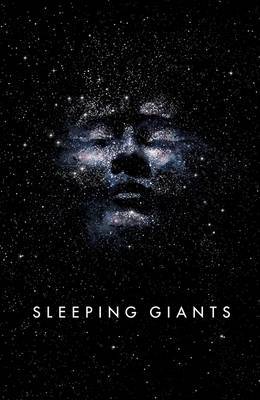
One of the novels that surprised me  last year was Sylvain Neuvel's Sleeping Giants, a clever mix of genres and themes. The story is located in a near future in which we discover various parts of the anatomy of a mechanical giant built in a strange and inexplicable metal alloy. Its discovery and dating breaks all the paradigms of archeology, so that it comes to the conclusion that they are of extraterrestrial origin. The novel narrates the search of the pieces, their investigation, assembly and essay, while the political relations between the different countries are changing due to this discovery. The story is explained through interviews (mostly), mission reports, transcription of recordings, personal journal entries ... This structure is key to make the reading agile, entertaining and addictive.

Today I will comment the second part of this saga, Waking Gods. Why change the formula that has given you success? Neuvel maintains the same narrative structure and the same use of the characters. Some of the mysteries of the first novel are solved, but other new ones are opened, much more intriguing. Unlike the previous one, that covered an ample period of time, the action develops in few weeks.
I think I've read it in less time than the previous one. I have devoured it, partly because I was already familiar with the scenario and the structure and, above all, because it is a very entertaining and addictive story.
The plot does not focus on the political and conspiracy part, but on the part of the action and the part of the history of our species and what happened when we contacted with the alien visitors. I must admit that a couple of twists in the plot have pleasantly surprised me, and I consider that Neuvel has been brave and not conservative: he could have chosen options that would have made it easier to continue with the plot, but he has decided to choose the difficult option.

We retake the story about ten years after the end of the first novel. The team of pilots and scientists continue to study the functioning of Themis, but with relatively little success. The action is triggered when in some of the most populated cities on the planet suddenly appear a dozen giant robots that, through the use of a very toxic gas, manage to eliminate more than 99% of the population that is within a radius of 20 kilometers from the robot. The story centers on the against the clock struggle for humanity's survival against this implacable threat.

In short, a second part that maintains the virtues of the first, a very agile and addictive reading and a vertiginous rhythm. The part of the action predominates more than that of the conspiracy, but that does not mean that it's less interesting. It solves some of the mysteries of the first novel, but opens many other questions. I really want to continue with the story, but, for the time being, the name of the third novel has not been made public, so we will have to wait.

diumenge, 19 de març del 2017

Luna: Wolf moon - Ian McDonald (english version)

Disclaimer: English is my third language,  so I want to apologize in advance for there may be mistakes in the text below. If you find any, please let me know so that I can correct it. I'd really appreciate it. Thanks. You can read this review also in spanish here.


Luna: New Moon by Ian McDonald was one of my favorite readings from last year. I was very surprised that it didn't win any of the important awards, but I was much more surprised by the variety of opinions that it gathered among the people I use to share comments with. Oppinions are extreme: you love the book, o you really hate it. 
In my oppinion this second part, Wolf Moon, is even better than the first, altouhgh those who did not like the first probably will not like it and I would not waste time trying,  because the structure and formulla is very similar. But  those who liked the first one will love this second one, because it maintains the virtues of the first, improves some defects, and introduces new  very interesting situations.
I 've read lots of comments comparing Luna with several kind of stories: a western,  a Venezuelan soap opera, and with A Song of Ice and Fire. I decided to qualify it more as a mix between Dune and the Godfather, and I maintain my position after reading  the second part.

The novel has two strong points:  the world-building and the plot. I love the moon that McDonald has created as a scenario, he is able to place us in that relentless habitat very easily presenting a lot of technological, architectural, and energetic details. I really liked how he talks about the physiological differences between people born on the moon and on Earth, and in the difficulty of adapting from one habitat to the other. Another great idea is the four elements that always have to be in green numbers in the account of the inhabitants of the moon: carbon, air, water and data, but it is a pity that it doesn't deepen into how the low classes manage the situation, since, as in the first novel, most protagonists are part of some of the richest families of the Moon, and they do not have these kind of problems. 
There is less presence of sex than in the previous novel, but the variety continues surprising me.
The part of the plot concerning the political and economic conspiracies between the families that have the monopoly over the different resources has interested me as much as in the first one, but the part of the action much more. There are shocking scenes on the surface of our satellite: knife fights, extreme survival, persecutions with Rovers ... very exciting and addictive.
                                  
        Look out!, from here some spoilers of the first novel

It's a very diverse and choral story, with many protagonists who have point of view, which makes it more dynamic, but causes that the plot is not so easy to follow. In the first book I commented that there were many similar characters that could get the reader confused. The fact that many of them died in the first book makes it easier, and some that were secondary become principal in this second book. Although I quickly got back into the story, I think I would have appreciated a little introduction-summary of the facts of the first novel.
The story places us a year and a half after the events with which the first volume ends, and has several parallel plots. On the one hand, it tells us how the younger members of the Corta family are surviving after the attack received by the McKenzie, and on the other hand the hard journey to the Earth by Lucas Corta to try to recover the lost empire. If we add that the McKenzie are going to explode into a civil war and that the governments of the Earth are increasingly interested in being the ones who manage the lunar resources, it raises us a new scenario of intrigue, adventures, and conspiracies that I have devoured with a greater interest than I did with its predecessor.

In short, a second part that I liked the same as the first, but has entertained me much more. Politics, economics, revenge, adventures, and survival in a hostile environment and a spectacular setting. Totally recommended.

dilluns, 13 de març del 2017

The collapsing empire - John Scalzi (english version)

Disclaimer: English is my third language,  so I want to apologize in advance for there may be mistakes in the text below. If you find any, please let me know so that I can correct it. I'd really appreciate it. Thanks. You can read this review also in spanish here.


The usual readers of the blog already know that I am a great fan of the work of John Scalzi. I am rarely disappointed, because I know what I am looking for when I read one of his novels: entertainment, fun, a quick reading story basically based on dialogues and a peculiar sense of humor that sometimes gets out of hand (not this time).
Although he presents good ideas and original books in other genres, Scalzi is accustomed to excel in space-opera, so his most important work is Old man's world saga, made up of 6 books. I have read 5 of them, and although I have liked them all (with more or less enthusiasm) I think the universe was already a bit worn out, so I consider it a wise move to have started a new saga with the novel that I present today, The Collapsing Empire .
It is a novel of introduction to a new universe, therefore the author has to make an effort to get the reader to feel comfortable in the new scenario and to present all the characters (it's a choral story). It has the advantage that it represents a novelty, therefore awakens interest, and in this case the drawback that the plot is a little loose and accelerated in the final part (and there is even some small error in the plot that has not convinced me).
Humanity has expanded through the galaxy thanks to the discovery of The Flow, a space that allows fast travel between the stars. There are few doors to the entrance and exit of this space, and in these areas, whenever there is a solid celestial body nearby, humanity has settled in it, although there is only one, End, that is a planet of the terrestrial type in which we can live without protection on its surface. Therefore, most humans live in artificial habitats on the surface of satellites or planets, or in orbital stations, since contact with the Earth was lost a long time ago.
Humanity is organized in an Interdepency, in which each human settlement specializes in one type of resource, and for the rest it depends on the commerce with the other colonies. Each settlement, and therefore each resource, is run by a noble family (this structure reminds me of Ian McDonald's Moon), and one of these families, based on the planet Hub, which is located on the central axis of the Flow, is the one that governs Interdependency.
The story begins with the death of the Emperox and the coming to power of his daughter, who is not prepared for it, since his brother, who was the heir, has died in an accident. As the title of the novel tells us, the empire is going to collapse because there will be a change in the space that allows the journey between human settlements that will leave them isolated slowly and inexorably.

The plot focuses more on political conspiracies and arguments related to the economy and trade than on the action, which I found very interesting, although there are a couple of very exciting action scenes. As I said before is a choral story, and most of the strong characters are women. Men are relegated to more sibylline roles, or to those who have to get saved.
During the first half of the book the rhythm is perfect, and the story very entertaining and addictive. There are two or three details of this new universe that I found great, but I can not comment to avoid making spoilers (although the title is already a spoiler in itself). Unfortunately, the plot runs out of steam in the final part.

In short, a light and entertaining novel that presents a scenario full of possibilities, full of good ideas and characters with charisma. It is a novel that introduces a new universe, and I think it has prioritized this aspect in front of the story itself, and that has impacted on the development of the plot, which has not completely convinced me.
Anyway, I sure will read the second part, The Last Emperox.

diumenge, 12 de febrer del 2017

The Bear and the serpent - Adrian Tchaikovsky (english version)

Disclaimer: English is my third language,  so I want to apologize in advance for there may be mistakes in the text below. If you find any, please let me know so that I can correct it. I'd really appreciate it. Thanks. You can read this review also in spanish here.


Since I opened this blog three years ago I've been reading more science fiction than fantasy. And when I've read fantasy I have chosen urban fantasy in front of epic fantasy, I have a certain surfeit of this subgenre, altough it has always been one of my favorites. The tendency to publish sagas instead of independent novels has saturated me.
That is why I choose very carefully my readings of this genre. Last year I read The Tiger and the Wolf, by Adrian Tchaikovsky, mostly because I enjoyed the author's previous novel a lot.
I found a novel with an original world-building, in which humans are able to transform into the totemic animal of the tribe they belong. The protagonist is a half blood, capable of transforming into a wolf and into a tiger. The plot narrates her escape of the tribe that has seen her grow, the wolves, when she discovers what they have in mind for her. The story of personal growth of the protagonist is mixed with a history of dark omens for the future of the world in which they live. Although the main protagonist lacks the necessary charisma to accompany the good background, the secondary ones were very interesting. My final assessment was not overly positive, especially since the novel is suffering from an excess of persecutions and ritual fights, but I ended up with interest in knowing how the story is going to evolve.

This year I've been very lucky with the second parts of the sagas I'm reading. I think Tchaikovsky in The bear and the serpent corrects the details that caused that the previous novel of the saga was not perfect.
The story is explained from many points of view (many more than in previous novel), with much more variety in the locations, and the rhythm is not affected by persecutions and struggles, which are not as abundant as in its predecessor. The plot becomes more complicated,  events of the past are clarified (although new mysteries are opened), new tribes and new enemies appear and there are really surprising plot twists. A  very entertaining novel, and totally recommendable, although with some failures that I will comment later.

Watch out! From here, spoilers of the first book, and some of the second.

The novel presents two very different plots. On the one hand Maniye, Hessec and Asmander return to the land of the Rivers to participate in the dispute between the two twin brothers who aspire to the throne. The division between the priests and the main houses of the river is about to trigger a civil war. In the cold north, Loud Thunder has the mission to reunite the priests of the different tribes to try to discover the threat that everyone predicts but nobody knows. The two plots advance in parallel, almost as if they were two independent novels, although in the background they are related. The changes between plots and between points of view of characters that are in the same plot is very well achieved and manages to maintain the interest and the tension throughout the story.
The characters have a really bad time, but with such a large cast, I think there should be more casualties of important characters. Accustomed to the stories of Abercombrie, Martin or Erikson this has seemed a bit innocent to me in this sense. Maybe the book  it's aimed at a different public, maybe young adults. I'm also afraid of how the author will explain the origin of the main enemy of the protagonists. If he chooses what I have intuited, I think it will be a little disappointing, but from what I read of him, the author deserves a vote of confidence, and therefore I will wait for the conclusion of the saga to be able to comment  it based on facts and not intuitions.

In short, an interesting saga for its world-building, for many of the characters (especially the secondary ones) and for its evolution, since this second volume improves and corrects the main defects that I found int its predecessor. I'm looking forward the next one.

diumenge, 29 de gener del 2017

Binti:Home - Nnedi Okorafor (english review)

Disclaimer: English is my third language,  so I want to apologize in advance for there may be mistakes in the text below. If you find any, please let me know so that I can correct it. I'd really appreciate it. Thanks. You can read this review also in spanish here.

Binti was last year's most triumphant novella, it has been awarded with the Hugo and the Nebula. The plot is starred by an intelligent young woman who is part of a very peculiar ethnic minority, the Himba, and who dares to contradict all the traditions of her tribe, as well as the prejudices of the rest of habitants of the Earth, to embark on a journey between the stars to the most prestigious university in the galaxy.
Although the universe created by Okorafor aroused my interest, my final assessment of the novel was not very good, I was left with the feeling that the key situations in the story were decided by a cluster of coincidences. Too many casualities and things that are not explained.
However, I was interested in how Nnedi Okorafor would continue the story, so today I present the second part, Binti: Home.

I've heard a lot of times that sequels are usually worse than the first part of a saga. Fortunately this is often wrong, and the novel I present today is a clear example of it.

This second part has totally convinced me. Several of the aspects that are not explained in the first one are clarified here, and, although new questions are opened, the various threads of history are better stranded. The plot is deeper and more attractive, a very interesting mix of tradition and ancient rituals with speculative science fiction.

LOOK OUT: From here, some spoilers of the first novel.

After a year at the University of Oomza, Binti and her friend Okwu, a Meduse, travel to Earth. Although at the beginning it explains some things about the functioning of the university, it is one of the aspects that causes me more curiosity of the universe that Okorafor has created, and I have been left wanting more. Binti must overcome the aftermath of her traumatic experience on the previous voyage, and she has many doubts about how her tribe will react to her new appearance, with the Meduse tentacles instead of her braided hair. The story will tell us the meeting of Binti with her numerous family, in a tense situation created by the presence of a Meduse on Earth, many years after the war that faced this species with ours.
I think Binti's story is about changes (at a physical level, but also mental and spiritual) and how to adapt to them, and is packed with many details and mysteries. The mixture of science fiction and tradition as a backdrop has just given an extra point to a story with a lot of interest, fully recommended.
The main drawback of the novel is its ending, a HUGE cliffhanger that I recognize has caught me by surprise. Well, that implies that there will surely be a third story of Binti. Here it will have an intrigued reader.

dissabte, 21 de gener del 2017

The fortress at the end of time - Joe M. McDermott (english review)

Disclaimer: English is my third language,  so I want to apologize in advance for there may be mistakes in the text below. If you find any, please let me know so that I can correct it. I'd really appreciate it. Thanks. You can read this review also in spanish here.


The main premise of the novel that I present today is very interesting: humanity has expanded through the galaxy thanks to a technology of transport between the stars, the ansible. This technology, in addition to transporting materials, allows people to be transported, but through an instant cloning process, so that at the destination point a clone is created with the personality and memories of the cloned person.

The colonists destined to populate new worlds are only cloned once, but the military who run the space stations of the colonies can be cloned later to different destinations if they merit enough.
This interesting argument is sprinkled with a good atmosphere: the colony is the farthest from the cradle of humanity, with an orbital station almost in ruins and the mission to monitor the possible return of aliens with which humanity has already fought. In addition, the planet on which the station orbits is at the beginning of the process of terraforming, and colonists must fight against high temperatures, lack of water and abundance of sand.
The main protagonist is Ronaldo Aldo, an ensign assigned to this station that tells the story in the form of a confession in which he will try to explain and justify each of his sins.
It is a pity that with such good ingredients the final result is not very good. Although during the progress of the plot there are some scenes and situations that arouse interest, the problem is that the author has not connected them correctly. The role of the different characters in the station is confusing, as well as their relationships and motivations. There have been times when I have not understood why things happen, and in others, I have become bored.
In its favor I will say that the resolution of the plot has seemed to me brilliant and surprising. Having such a good argument and scenario and a correct ending, the main problem lies in the length of the story: I think that what is a novel at times boring and disjointed, polishing some details would have been an excellent novella, even with  merits to be nominated for the big awards.

In short, a pity. Although the novel has not convinced me I will be attentive to what this author publishes, I really liked some of his ideas.

diumenge, 25 de desembre del 2016

Miniatures: The very short fiction - John Scalzi (english review)

Disclaimer: English is my third language,  so I want to apologize in advance for there may be mistakes in the text below. If you find any, please let me know so that I can correct it. I'd really appreciate it. Thanks. You can read this review also in spanish here.

I am a big fan of the work of John Scalzi. His imaginative and fun style is perfect between more complicated and profound readings. I have read almost all of his work: five books of his iconic saga  Old Man's War (except Zoe's tale), and his independent novels, such as Lock In or Redshirts, for example.
Still, I must admit that I would not have given a chance to the anthology that I present to you today, which includes his best short narrative (no, better VERY short: a maximum of 2500 words), if it does not come to be by the complimentary comments of my friend Leticia Lara in her blog  Fantastica Ficcion.
And I would have made a great mistake, because in these brief stories the wit and the sense of humor of Scalzi shine with their own light and have the perfect dose. It happens to me often when I read stories in which humor has a very important weight that jokes become repetitive if the story is too long.
It is not a book for laughing out loud, but you will devour its pages with a constant smile in your face.
I have read these stories in a week that I had very little time to read, and the  length of the stories is perfect for these situations: few pages, and a complete and entertaining story. Although I am convinced that if I had caught it in a moment with time I would have read it in a couple of hours at most.
The anthology consists of 17 stories and a poem and, because of its brevity, commenting them is synonymous of spoiling them, so I will limit myself to mention the general themes of which they treat.
The main subject that touches Scalzi and that also appears very often in his work of greater length is the contact with extraterrestrial beings. But not the first contact and the discovery, but the conflicts that would derive from the daily coexistence with beings totally foreign to us. He knows how to get a lot of juice out of these situations.
There are also a couple of fun stories related to superheroes and supervillains, and another couple related to artificial intelligence and their opinion of humanity. Although if I have to highlight one, the one I found most ingenious has been an interview with Pluto after it became a dwarf planet instead of a planet. 

In short, a very entertaining and enjoyable reading, totally recommendable. In March Scalzi is going to publish the first novel of a new saga of space-opera, The Collapsing Empire, and the reading of these small stories has increased my desire to read it. I have the ARC ready in the reader, so in a short time it will appear here.

dijous, 10 de novembre del 2016

The four thousand, the eight hundred - Greg Egan (english version)

Disclaimer: English is my third language,  so I want to apologize in advance for there may be mistakes in the text below. If you find any, please let me know so that I can correct it. I'd really appreciate it. Thanks. You can read this review also in spanish here.

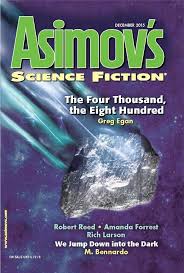
Another great author I deleted from the list of those who had not yet appeared on the blog. I know Greg Egan more for his short stories than for his novels, the compilations Axiomatic and Luminous, among other anthologies of other authors, were partly responsible for my current interest in short narrative. Today I will comment  a novella, The four thousand, the eight hundred, that had already appeared in  Asimov's magazine and Subterranean Press will publish it in a few weeks.
I perceived a change of style with what I had read so far from this author. The plot is much more affordable than some of his stories, with very interesting sociological reflections, but not with philosophical reflections that caused the reading to be sometimes stodgy, and neither would I qualify it as hard science fiction, subgenre in which Egan stands out.
The atmosphere is very interesting. The story is located in the two great asteroids of the belt, Vesta and Ceres. There are human colonies in both of them, and between them there is an exchange of materials in the form of huge blocks that travel slowly in space. Ceres exports blocks of ice and Vesta blocks of rock to supply the deficiencies of the other asteroid.
The societies of the two satellites are similar, but in Vesta a situation occurs that causes that part of the population, descendants of a group of the original settlers, is undergoing an active and very powerful discrimination by a great part of the rest of the population. Although events of protest and even sabotage are organized, the situation does not change, and much of this population chooses the slow exile to Ceres in survival capsules installed in the blocks of rock.
Egan touches one of the burning issues of our society, unfortunately: the refugees and their dangerous travels to reach an area where they hope to find shelter and well-being. It is inevitable to think of the parallelism between the Mediterranean Sea and the emptiness in which the blocks move with their stowaways.
It is a pity that the final situation, in which the maximum tension occurs, is resolved very precipitously. A few more pages and a little more explanation to make the resolution more gradual would have improved the final result. It is not the best thing I have read of the author, but it is a very correct novel and I recommend it to you.

diumenge, 6 de novembre del 2016

Bridging infinity - Jonathan Strahan (english version)

Disclaimer: English is my third language,  so I want to apologize in advance for there may be mistakes in the text below. If you find any, please let me know so that I can correct it. I'd really appreciate it. Thanks. You can read this review also in spanish here.

One of the anthologies I liked last year was Meeting infinity, the fourth book of the Infinity project led by Jonathan Strahan. In this project each book consists of stories with a common axis to analyze the future evolution of humanity. In the case of the book that I present today, Bridging infinity, the fifth one, the main subject is great engineering projects.
Like all anthologies written by various authors is very irregular and diverse, but in this case much more since the authors have chosen very different visions of the project, especially  the temporary location, so that there are stories located in the coming decades, but also in the coming millennia. This generates a loss of homogeneity that is what gives more meaning to this project in my oppinion.

The lineup of authors is spectacular, with well-known authors, but in the end, of the 15 stories, there are few that I consider memorable. Everything starts well, since the first three stories are very good, and they have in common, apart from that are very didactical, the exploration and modification of our solar system, but with very different styles.
Alastair Reynolds chooses research and exploration of the structure of the Sun as the goal of his story Sixteen Questions for Kamala Chatterjee, although it contains some surprises. Pat Cadigan in Sixteen Degrees of Separation freedom focuses on the construction of new habitats in the satellites of Jupiter and bodily and emotional changes that will suffer the first colonist. And in the third story, The Venus Generations, Stephen Baxter uses as a main character a long-lived family in the complicated process of reversing the greenhouse effect in order to terraform Venus.


There are a couple of stories I want to highlight for the engineering project they are descriving, and which are those that have generated me more sense of wonder. Robert Reed shows his mastery with Parables of Infinity, an interesting story about an ancient IA who works as a construction worker in a huge generational ship. Although who wins the prize is Allen M Steele with Apache Charley and the Pentagons of Hex, which is about a Dyson sphere made up of thousands of different habitats occupied by alien species. Trains travel between these different habitats, and the story talks about a group of human vagabonds that survive among them. A spectacular scenery I've discovered that has already been used in other of his works and that I'll investigate.
Ozymandias, by Karin Lowachee, explains the story of the robotic construction of a huge  spacecraft, from the point of view of the only human who supervises of the project. I liked this one for the use of humour. Instead, I highlight The city's edge, by Kristine Kathryn Rusch by the atmosphere of mystery, and the sadness and despair of its main character. 
Several of the stories deal with the effects of climate change. From his group I particularly liked Cold Comfort, by Pat Murphy and Paul Doherty. The protagonist is a scientist who is developing a system to collect methane from the thawing permafrost, and the story tells how the project evolves. From the scientific point of view it has seemed me plausible, which is disheartening, because the tone of the story is not exactly optimistic.
And to finish the book, the best story, the one by Ken Liu, Seven Birthdays. Excellent, as usually happens. The story is about seven moments of the long life of the protagonist, but I'd rather not comment much more to not spoil the reading. Just for this story worth it the book.
In short: I liked more the previous anthology, but the quality of many of the stories of this one is very high. The problem is that there is much difference between them; I have liked ones a lot and others very little, so the overall rating is not as high. I'll still be aware of this project, both for future editions (I hope that there will be), as for the three I have not yet read.

dimecres, 17 d’agost del 2016

The Dream-Quest of Vellit Boe - Kij Johnson (english version)

Disclaimer: English is my third language,  so I want to apologize in advance for there may be mistakes in the text below. If you find any, please let me know so that I can correct it. I'd really appreciate it. Thanks. You can read this review also in spanish here.


I discovered Kij Johnson thanks to the stories published by Marcheto in his fantastic page Cuentos para Algernon. I liked his style and later I searched several of its most prominent stories (which are many, as she has been a finalist and won the Hugo and Nebula among other great prizes) and even I dedicated an entry to her stories long ago. When I saw that Tor was going to publish her new novella The Dream-Quest of Vellit Boe, I could not resist myself.

The story tells us  the  travels of a professor of an exclusively female college following one of her students, who has fled from the city, captivated by a man from another world. From our world, in fact, since the story is set in the world of dreams, in which some dreamers of our reality can enter through certain magical doors and interact with its inhabitants. The disappearance of the girl could create serious problems for the university, so Vellit Boe, ancient traveler and very knowledgeable about the ways and customs of her world, begins her search in order to get her back before they embark on their journey to our reality.
What I did not know and did not discover until the end of the novel was that it was influenced/based on a story written by HP Lovecraft, The Dream-Quest of Unknown Kadath, which was located in a dream world, seting of several stories written by the writer of Providence, and that I was totally unaware of. I say was because I remedied the situation, since, convinced that the reading experience of the novel of Johnson should be totally different depending on the degree of knowledge of the work of Lovecraft, I decided to listen and read some of the stories set in his Dream's world.


My first impression without knowing the history of Lovecraft's novel is that the novel of Johnson is entertaining, but weakens in the plot. It is a narration of travels in a very rich and imaginary world but in which the author does not dwell, since only gives certain details of the different landscapes and cities through which passes the protagonist. Yet the author hooked me, but although the road is entertaining the ultimate goal disappoints a bit. I did not like the fact that the old adventures of the protagonist are so influential in the plot, too many coincidences a little forced in my opinion so that the pieces fit. Instead I found very original the part of the underworld with its strange beasts, ghouls, ghasts and gugs.

The universe piqued my curiosity and in recent days I have read several of the stories of Lovecraft located in the land of dreams. It is very interesting as The Dream-Quest of Unknown Kadath refers to several of them. The problem is that with such a recent reading the positive view of the story of Johnson changes a little, because much of what I thought was original and enjoyed is already present in the work of Lovecraft. It is true that with a touch a little more modern (the use of dialogues, the action scenes ...), but the background is similar, deliberately, I think. The most distinguishing aspect is the feminine presence.
The author justifies her creation at the end saying that when she read the original story in her childhood she felt uncomfortable by the racism in the world created by Lovecraft, a fact in which we agree. Later she also felt uncomfortable by the total absence of women in the story, so basically it's the reason of the choice of female characters in her novel. There seems to be consensus among experts on racism of Lovecraft, but there are different opinions about his misogyny.

In short, I think it's a story that can enjoy those readers who discover this fantastic universe whith this story and then want to delve into it (as in my case), but I doubt more to recommend it to those who are already familiar with Lovecraft's work. But it can always be a good reason to return to the world of dreams and I'm sure they will enjoy picking references and Easter eggs.

Ah ... and I recommend it to cat lover's, of course.

dilluns, 8 d’agost del 2016

Time Siege - Wesley Chu (english version)

Disclaimer: English is my third language,  so I want to apologize in advance for there may be mistakes in the text below. If you find any, please let me know so that I can correct it. I'd really appreciate it. Thanks. You can read this review also in spanish here.


Sometimes the assessment you make of a story on the spur of the moment is quite different of the one you would make when some time has passed and the feelings that it has generated in you mature. It happened to me recently with Time Salvager, by Wesley Chu, a novel I read last summer. It is a story with a very interesting scenario, a post-apocalyptic future in which the only way that humans get certain resources is traveling to the past and taking them trying not to alter the timeline (in boats about to sink, spaceships about to explode, cities about to be destroyed ...). I liked the atmosphere and the first part of the book is very entertaining. An impulsive decision of the protagonist, one of these time travelers, little explicable in my opinion, created a situation of conflict that eventually leads from a story that was promising and full of ideas  to a more conventional story, of action, persecutions and romance.

Although the story did not quite convince me and I had not planned to continue with the saga (yes ... is another trilogy) when the possibility of asking the second part, Time Siege, in Netgalley appeared, I decided to give it a try.
The truth is that it has been worth it, it's a good novel to read on vacation time, a very entertaining blockbuster, like its predecessor, but with a better organized and constructed story.
There is more variety of views, as some of the secondary characters of the first part gain prominence, some others change roles, and interesting new additions appear. On the other hand, the atmosphere is more monotonous, since much of the action centers on the island of Manhattan of the future, full of skyscrapers half in ruins and connected to each other, where many of the savage tribes descended from the original inhabitants of the earth live.
Wesley Chu dominates very well the use of the action scenes, thrilling and exciting, but repetitive in some moments, like some of the introspective scenes of the main character. I think overall the novel has too many pages, but the last part has hooked me, both the intrigue and the action part, and the end left me pleasantly surprised, presenting a very interesting  scenario and leaving me wanting to end the saga, which, frankly, I did not expect when I finished the first novel. If it continues with this progression, the end of the story promises.

dimarts, 12 de juliol del 2016

The Ghoul King - Guy Haley (english version)

Disclaimer: English is my third language,  so I want to apologize in advance for there may be mistakes in the text below. If you find any, please let me know so that I can correct it. I'd really appreciate it. Thanks. You can read this review also in spanish here.


Three months ago I commented on the blog The Emperor's Railroad, by Guy Haley, one of the novellas published by Tor. It is a strange and successful blend of epic fantasy  and post-apocalyptic novel seasoned with zombies and angels and full of misteries about the causes of the situation that reflects the plot of the novel. The worldbuilding is very interesting, the  style is attractive and the protagonist intriguing. I really wanted to know more about the universe that Haley has created , so I was waiting for the second part, The Ghoul King.

The story is set just after the previous novel, and uses a very similar structure, as it is also told in past and in the first person by one of the secundary protagonists that has been a spectator of the wanderings and adventures of Quinn, the Knight, on the road that leads to his mysterious goal (in this second part it have often come to my mind the character of the Gunslinger in The Dark Tower by Stephen King, with whom Quinn has some similarities).

Contrary to what uses to happen to me, I liked this second part better than the first. The story is more attractive, is better structured, and, above all,  some of the mysteries that arose in the previous novel, as the origin of the Angels, are solved satisfactorily and surprisingly. Although the solution to the puzzles causes that new questions are opened, leaving the reader satisfied one hand and intrigued by the other, which has a lot of merit.
I do not know if it is because the doses are the right size or they are properly spaced in time, but I am hooked, and I really want to know more about the fascinating universe of The Dreaming Cities, in which I hope Guy Haley will immerse once again to explain more adventures of the enigmatic knight Quinn.